MyCameraConstraint Class Reference
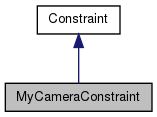
Public Member Functions | |
| MyCameraConstraint (qglviewer::Vec min, qglviewer::Vec max) | |
min and max are the bouding-box on which the camera will be constrained | |
| virtual void | constrainTranslation (qglviewer::Vec &t, qglviewer::Frame *const fr) |
Filters the translation applied to the frame. | |
Public Attributes | |
| qglviewer::Vec | maxP |
| qglviewer::Vec | minP |
Detailed Description
Definition at line 352 of file renderworld.cpp.
Constructor & Destructor Documentation
| MyCameraConstraint | ( | qglviewer::Vec | min, |
| qglviewer::Vec | max | ||
| ) | [inline] |
min and max are the bouding-box on which the camera will be constrained
Definition at line 355 of file renderworld.cpp.
Member Function Documentation
| virtual void constrainTranslation | ( | qglviewer::Vec & | translation, |
| qglviewer::Frame *const | frame | ||
| ) | [inline, virtual] |
Filters the translation applied to the frame.
This default implementation is empty (no filtering).
Overload this method in your own Constraint class to define a new translation constraint. frame is the Frame to which is applied the translation. It is not defined const, but you should refrain from directly changing its value in the constraint. Use its Frame::position() and update the translation accordingly instead.
translation is expressed in local frame coordinate system. Use Frame::inverseTransformOf() to express it in the world coordinate system if needed.
Reimplemented from Constraint.
Definition at line 361 of file renderworld.cpp.
References Frame::inverseTransformOf(), Frame::position(), and Frame::referenceFrame().
The documentation for this class was generated from the following file:
- worldsim/src/renderworld.cpp